Everyone can fall, but as people get older, they’re more likely to have problems with balance. Add to that the increased risk of serious injury from falling, and you have good reason to look at your home with a critical eye. Keeping the home safe for seniors is a key part of aging in place. Use this room-by-room checklist to identify the hidden hazards lurking in your home, with some simple solutions to address them.
How to Make Every Room Safer For Seniors
Whether you’re buying a home as a senior or just want to improve the safety of your current home, mobility is the key. Fall prevention goes a long way to make every room safer for seniors. But what’s the best way to do that? Let’s take a look room by room.
Entryways
In order to make every room safer for seniors we need to start at the beginning—the entryway. If we begin at the entrance to the house, you may immediately see some possible tripping or falling hazards. Look at the transition between the front porch and the entryway. Is the step in good condition? Is the welcome mat easy to shift, or does it wrinkle when you nudge it with a toe?
Once you get inside, look for other hazards. An overflowing coat rack may be easy to reorganize or put into the coat closet. Wall shelves, baskets, hooks and shoe racks can be simple solutions to manage clutter next to the doorway.
Also keep in mind, that most of the time the owner of the home will enter through a door that’s not the home’s “front” door. So these same guidelines should be followed with other entry points.
Staircases
Staircases can be notoriously difficult for people with mobility concerns to navigate. Single-level living may be the ideal solution to reduce risk, but for people who live in multilevel homes, there are plenty of options to help:
- Place baskets at the bottom and top of the staircase to keep clutter off the stairs.
- Install a firm handrail on both sides to support movement.
- Check the condition of the flooring and fix loose carpet, steps, or treads.
- Add lighting for easier visibility.
In some cases, installing a stair lift may also be a helpful choice. Please keep in mind that staircases are the number one location for senior falls. With bathrooms coming in second.
Kitchens
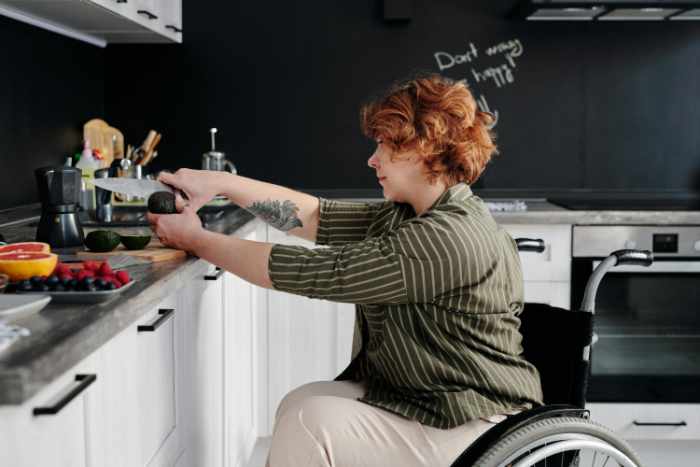
A clean, uncluttered kitchen can be simple to maintain, which minimizes the amount of movement required when doing food prep, cooking, or eating. When using a mat near the stove for comfortable standing, make sure that it is nonslip and tapered around the edges. Keep the most common items on shelves closest to the countertop, for easy access. Install nightlights under the upper cabinets to provide nighttime illumination for taking medication or grabbing a quick snack. If you really need a step stool, consider buying a sturdy option with a handlebar for balance.
Bedrooms
To test out common problems in the bedroom, try shuffling around the floor without bringing your feet more than an inch above the ground. Do you stumble over a sliding rug? Does your foot catch on a lamp cord? Do you bring up a lot of dust bunnies from under the bed? Make a list of the issues you find. Use clips to keep cords out of the way. Remove rugs or buy nonslip varieties. If the bedrooms are the only rooms with carpet, consider placing a lightweight vacuum for easy cleanup. If possible, install hard flooring or carpet with a low profile.
Bathrooms
When we want to make every room safer for seniors we should pay extra attention to bathrooms. Although they can be fraught with hazards, there are a variety of low-cost tools to help:
- Install sufficient lighting, including in the shower.
- Place grab bars next to the toilet, shower, and bathtub.
- Upgrade the bathroom fan to remove excess moisture from surfaces, especially floors.
- Install a nonslip mat on the shower floor or bathtub.
For your next bathroom update, think about fixtures that help with aging in place. Comfort height toilets and curbless walk-in showers simplify movement and comfort during daily hygiene tasks. If you have the space, add a vanity and chair for doing makeup and hair.
Living Areas
The major living areas are commonly full of problems, but thankfully most of them are easy to solve. If you haven’t already switched to hard flooring surfaces instead of carpet, now is the time to consider it. Instead of using loose rugs for warmth, put a pair of slippers or a small throw blanket in a basket near the couch or chair. Organize cables with clips and install wall shelves instead of low-lying tables. If you switch flooring between rooms, keep the transitions as flat as possible, to minimize stumbling.
Hallways
Hallways tend to get short shrift in a room-by-room checklist, but they can be jam-packed with unexpected hazards. Most hallways are too dark, particularly at night. Install lighting at both ends and make it easy to turn on and off. Use hooks or wall baskets to confine clutter, especially if your household has a tendency to leave shoes, bags, or coats in the hallway. Measure the width of the hallway and confirm that it is large enough to accommodate a wheelchair or walker at the widest angle.
For individuals receiving Alzheimer’s care, extra precautions are often needed because memory loss and disorientation can increase the risk of tripping or falling. Clear pathways, secure flooring, and consistent lighting can make a big difference in maintaining both safety and independence. Aging in place doesn’t have to be scary if you make the right adjustments. By making a few simple improvements to each room, you can reduce the risk of falling and keep everyone in the home safe and sound.
We hope you have enjoyed this helpful article on how to make every room safer for seniors. Come back upcoming posts that we’re consistently posting.
Author: Kandyse Morales is the Manager of Home Care Services at Hearts at Home Senior Care, which provides caregiving services to seniors and others in the Houston, San Antonio, and Austin, Texas areas. Morales holds a master’s degree in social work from Metropolitan State University of Denver and has dedicated many years to supporting families through a variety of health and human services agencies.